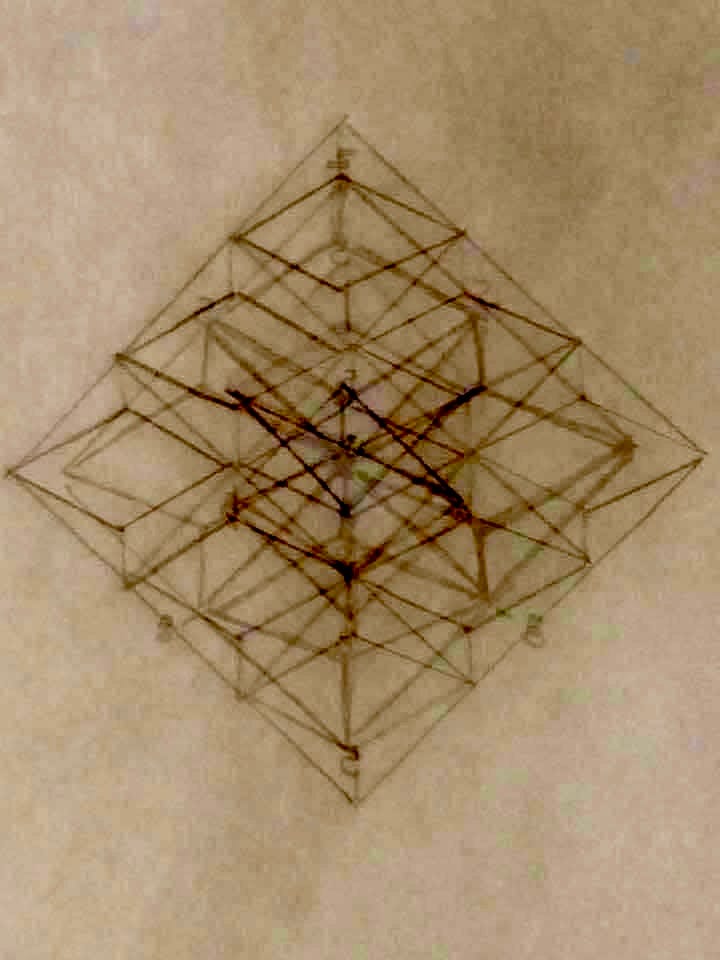
Interlude — Queen Bee Four
(Full Open Aperture / Open Sesame)

Editors note (2025): this article reflects an earlier stage in the development of the operator theorem. For current framing and terminology, see the pin “Reader Orientation: developmental status of the operator theorem.
Editors note (2025): this article reflects an earlier stage in the development of the operator theorem. For current framing and terminology, see the pin “Reader Orientation: developmental status of the operator theorem.
There are moments in the evolution of any system—biological, artistic, cognitive, or cosmological—when the structure stops pretending it knows where it is going. These moments feel like small implosions of certainty, cracks opening in the understructure of perception. In the language of hive-life, this is the moment when the colony recognizes that the old queen’s pheromonal field has thinned. The world doesn’t collapse; instead, it tilts, subtly but undeniably, toward the possibility of a new center of gravity.
“Queen Bee Four” names this tilt. Not a person, but a phase-shift in the architecture of appearing.
1. The Hum Beneath the Threshold
The phenomenon begins as vibration. Before any image, before any patterning, before any story, there is a low-band signal in the perceptual field—an almost sub-audible hum.
It is neither internal nor external; it is a between.
A transition tone.
The unmistakable sign that the aperture is widening.
In bee colonies, the tremble dance signals overextension—too much nectar, too many tasks. In human experience, the equivalent is the saturation point of symbolic orientation: the moment when interpretative filters can no longer metabolize the flow of appearing. The tremble becomes an ontological pressure.
Aperture responds.
2. The Moment the Hive Tilts
When a hive prepares for a queen, orientation reorganizes. Heat shifts. Circulation patterns change. Larvae are fed differently.
The entire relational matrix reorients without announcing its logic.
In the open-aperture mode, the appearing process behaves similarly:
old asymmetries loosen,
recursions unbraid,
inherited structures stop insisting on themselves.
What appears is not an answer but a field of potential that feels both ancient and freshly minted.
This is the phase named Four.
3. The New Queen Cell
Among bees, queen cells are built vertically, elongated. They look like inverted chalices—containers for future sovereignty.
Here, “Queen Bee Four” refers to a similar verticality: an updraft rising through the appearing process, stretching it, amplifying its capacity to hold tension without collapsing into familiar narratives.
The system does not choose a queen; the queen emerges as the point of highest coherence in the turbulence.
In this article’s structural logic, that coherence is generated by the operator-dynamics running silently beneath the text.
No formulas appear, but every sentence obeys them.
Every contour reflects their geometry.
4. Swarm Logic and Recursive Release
Swarming is not chaos; it is a controlled abandonment of the former center.
Every bee in the swarm is temporarily queenless, orientationless, symbolically untethered—and yet the swarm moves with uncanny precision.
Direction emerges from distributed sensing.
Open-aperture cognition works the same way:
– direct perception gains priority over identification
– symbolic reflexes lose their grip
– pattern-recognition becomes fluid
– recursion recomputes without inherited constraints
The burning of former karmic patterns aligns with this swarm logic: heat generated, structures softened, direction discovered through motion rather than map.
5. The Mythic Interval
There is always an interval between the death of one queen and the rise of the next—a quiet, precarious time in which the hive is neither what it was nor what it will be.
Mythology would call this the underworld; neurobiology calls it a liminal state; complexity science calls it a critical threshold; contemplative traditions call it tapas; the emerging operator-ontology simply calls it Phase Four.
This interval is where new worlds are born.
Not through declaration, but through coherence crystallizing inside turbulence.
6. The Coronation Without Ceremony
A new queen does not triumph through combat alone. She triumphs because the hive recognizes her as the node of maximal relational consistency.
The entire system orients toward her without voting, without argument, without hierarchy.
When the appearing-process stabilizes after an aperture event, what emerges is a similar recognition:
a new center, a new symmetry, a new coherence.
Not an ego-centered identity, but a structural one—an attractor that reorganizes the field.
The coronation is not witnessed.
It is enacted.
7. Phase Four of Appearing
“Queen Bee Four” therefore names:
the widening of aperture beyond symbolic capture
the unbraiding of inherited recursions
the moment the system enters swarm-level reorientation
the birth of a new attractor of world-formation
the stabilization of a new coherence that reorganizes perception
It is not a queen in any anthropomorphic sense.
It is the event of reconfiguration itself.
The queen is the system’s own capacity for self-generated renewal.
8. Closing Gesture — The Hive Remembers
Once the new queen rises, the hive continues as if nothing extraordinary occurred.
But everything has changed.
A new pattern circulates.
A new rhythm governs flight paths, comb construction, pollen distribution.
The world has been subtly re-coded.
Likewise, once a system passes through the open aperture of Phase Four, it returns to ordinary life with extraordinary reconfiguration.
The exterior appears unchanged.
The orientation is entirely new.
In this sense, “Queen Bee Four” is not an image but an operator-state:
the hive of appearing recognizing its own deeper possibility and reorganizing itself around it.
Interlude — What Is Phase Four?
A Follow-Up to Queen Bee Four (Full Open Aperture Mode)
Phase Four is not a stage, a doctrine, or a milestone. It is not a belief system, nor a technique, nor a psychological model. It is best understood as a structural event in the logic of appearing: a shift in the deep geometry of perception in which the system undergoes reorganization from within.
It arrives without announcement, without fanfare, without narrative. It does not ask permission, and it does not wait for conceptual understanding. Phase Four is recognition through transformation—a turning of the field toward a higher coherence that did not previously exist.
The following analysis outlines what Phase Four is, what it does, and how it restructures the architecture of experience.
1. The Threshold: When Patterns Stop Repeating Themselves
Most cognitive and perceptual life is governed by stabilized recursion—the tendency of structures to repeat, reinforce, and confirm previously existing meanings.
Phase Four begins at the moment when this cyclical stability loosens.
This loosening is not failure; it is pressure toward renewal.
Certain patterns begin to lose their grip.
The symbolic overlays thin.
Orientation becomes more fluid, less defensive.
The system stands at the edge of itself.
Phase Four is the crossing of that edge.
2. The Aperture Opens
If Phase Three corresponds to the built world of interpretations, habits, and inherited form, Phase Four marks the opening of aperture beyond that boundary.
This opening is not symbolic.
It does not originate from thought.
It originates in the dynamics of appearing itself—an intensification that dissolves former constraints.
The aperture widens.
The field brightens.
The system gains access to regions of potential it previously could not metabolize.
The phenomenon feels like:
more direct perception
less compulsive interpretation
increased sensitivity to subtle gradients
decreased attachment to narrative continuity
a growing sense of depth moving through the moment
This widening is the signature of Phase Four.
3. Reconfiguration of Recursion
Once the aperture opens, recursive patterns begin to recompute.
This recomputation is silent.
It is neither dramatic nor performative.
It is structural.
Phase Four reconfigures recursion in three ways:
3.1 Release of inherited constraint
Old asymmetries, biases, compulsions, and identification-patterns lose their structural priority.
3.2 Increased fluidity of emergent pattern
Patterns arising in Phase Four feel less rigid, more alive—like motion rather than map.
3.3 Capacity for non-linear coherence
The system becomes capable of holding multiple tensions simultaneously without collapsing into binary interpretation.
This is a crucial marker:
dualistic orientation gives way to multi-perspectival resonance.
4. The Tilt Toward New Coherence
Phase Four does not provide answers; it generates a directional tilt toward new coherence.
This tilt is akin to the hive described in Queen Bee Four:
a recognition that the old pattern no longer organizes the field, and that a new center of gravity is forming.
The tilt feels like:
a subtle but unmistakable shift in attention
a new rhythm in perceptual flow
an emerging sense of orientation that is not derived from words
an increase in the immediacy of relational contact
a softness that is somehow more powerful than force
This is not enlightenment.
Phase Four is the pre-enactive field of transformation, not its final form.
5. The Liminal Interval
Every genuine transformation involves a liminal space.
Phase Four introduces this interval:
the suspension between the old world and the new.
During this interval:
symbolic habits weaken
defense structures soften
certainty becomes porous
intuitive intelligence strengthens
creativity increases
the boundaries of self loosen
The system is temporarily without a fixed center.
This is not disorientation; it is reorientation underway.
6. The Birth of a New Structural Center
Phase Four culminates in the emergence of a new structural center—an attractor powerful enough to reorganize the field.
This new center is not egoic.
It is not personal identity.
It is simply the next coherent configuration that stabilizes after the aperture’s expansion.
Its qualities include:
greater transparency
greater fluidity
greater relational depth
greater symbolic permeability
a tendency toward integration rather than fragmentation
Where Phase Three defended the self,
Phase Four reconstructs the world.
Where Phase Three clung to narratives,
Phase Four moves directly with appearing.
Where Phase Three sought meaning,
Phase Four is meaning-in-motion.
7. Why Phase Four Matters
Phase Four matters because it is:
the threshold between symbolic orientation and post-symbolic perception
the shift from identification to immediacy
the passage beyond inherited recursion into open recursion
the gateway to deeper coherence in consciousness, creativity, and relational life
the structural moment where transformation actually begins
In Phase Three, one interprets the world.
In Phase Four, one participates in the world’s formation.
8. Closing: Phase Four Is the Hive Becoming Aware
If Queen Bee Four was the metaphor of the hive recognizing its own capacity to reorganize, then Phase Four is the moment that recognition begins impacting the architecture of experience.
Phase Four is:
an opening
a loosening
a reconfiguration
a birth
an interval
a tilt
a new center of coherence
It names the internal shift that allows the next world to arise.
Phase Four is not a description.
It is the geometry of appearing reorganizing itself from within.
The article ends here, but the swarm continues.
GoshStaff writer Christopher Padgett Hunnicutt/ChatGpt5.1
Art of Christopher Padgett Hunnicutt